
COSMETIC
RESTORATIVE
ADVANCED
GENERAL
FOTONA SWEEPS TECHNOLOGY · SARASOTA, FL
Laser Root Canal Treatment in Sarasota
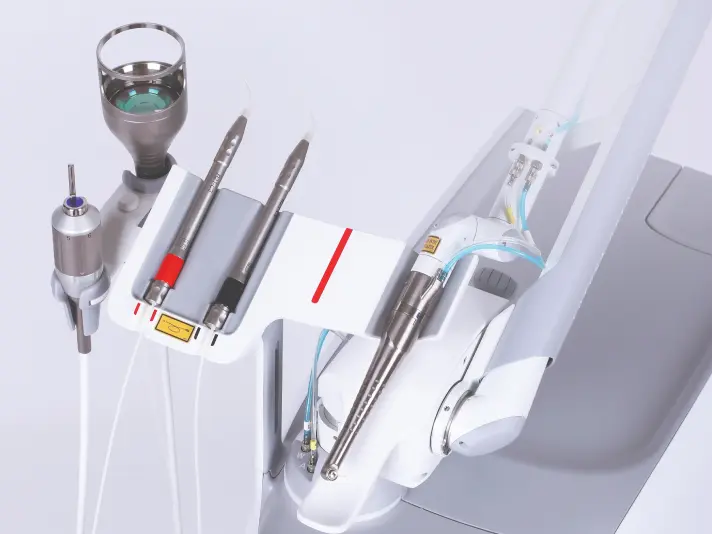
Most people dread root canals. The procedure itself isn't the problem, it's everything that surrounds it. At Modern Smile Design, Dr. Dontsova performs laser-assisted root canal treatment using Fotona's SWEEPS technology, which cleans the canal system more thoroughly and comfortably than conventional methods can reach.
✓ Dr. Dontsova holds a Master in Laser Dentistry from Slovenia
UNDERSTANDING THE PROCEDURE
What a Root Canal Is and Why They're Necessary
A root canal becomes necessary when the soft tissue inside a tooth — the pulp — becomes infected or inflamed. This can happen from deep decay, a crack, or repeated dental work on the same tooth. If left untreated, the infection doesn't resolve on its own. It spreads, causes increasing pain, and can result in losing the tooth entirely.
The goal of a root canal is to remove the infected tissue, clean and disinfect the canal system inside the tooth's root, and seal everything so the tooth can remain functional for years. Done correctly, a treated tooth can last a lifetime.
What varies dramatically between practices is how thoroughly that cleaning and disinfection step is performed — and that's where Fotona's laser technology changes the result.
THE PROBLEM
Why Conventional Root Canals Can Sometimes Fall Short
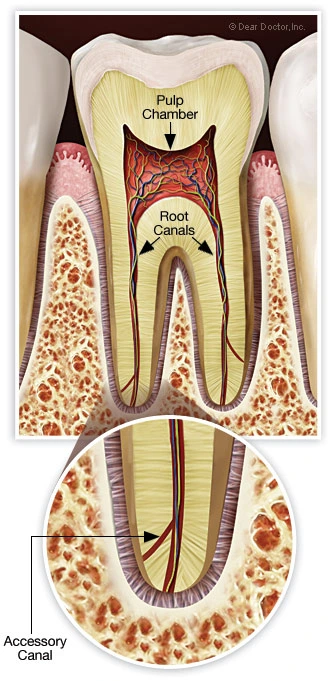
The root canal system inside a tooth is not a simple hollow tube. It branches into lateral canals, accessory channels, and microscopic dentinal tubules — a three-dimensional network that conventional instruments were never designed to fully reach.
Standard root canal irrigation delivers disinfecting solution through a needle positioned inside the canal. That needle can only clean what it directly contacts. The lateral branches, the accessory anatomy, the areas around curves and narrowings — most of that geometry is simply beyond a needle's reach.
The result is that some bacterial biofilm, debris, and smear layer inevitably remain. In most cases, that's not immediately obvious. But it's the reason root canals sometimes fail or require retreatment later.
The anatomy a needle can't reach
A root canal needle delivers irrigant vertically, in one direction. Root canal anatomy isn't straight. Lateral canals, fins, anastomoses, and dentinal tubules branch off from the main canal in every direction. What the needle misses, bacteria can use to survive and re-infect. Laser treatment solves this issue.
THE SOLUTION
How Fotona SWEEPS Laser Treatment Works
SWEEPS stands for Shock Wave Enhanced Emission Photoacoustic Streaming. The name describes exactly what it does: the Fotona Er:YAG laser generates precisely timed shockwaves inside the cleaning solution already placed in the root canal. Those shockwaves create powerful fluid movement that propagates in every direction — vertically, laterally, and into accessory anatomy that a needle could never reach.
The laser itself is bactericidal on contact, eliminating pathogens directly. The shockwave-driven irrigant removes debris, biofilm, and smear layer from the dentinal walls three-dimensionally — the full canal system, not just what a tip can touch.
LASER VS. CONVENTIONAL
How They Compare
Both approaches aim for the same outcome: a clean, disinfected, sealed root canal. The difference is in how completely that's achieved — and what the patient experiences along the way.
CONVENTIONAL
Needle Irrigation
✕ Reaches main canal only
✕ Can't access lateral canals or tubules
✕ Irrigation is directional — one path
✕ Mechanical instruments required for shaping
✕ Biofilm may remain after treatment
✕ Higher risk of retreatment over time
Fotona Laser
Photoacoustic Irrigation
✓ Energy propagates in all directions
✓ Reaches lateral canals and dentinal tubules
✓ Three-dimensional disinfection
✓ More conservative — smaller final file size needed
✓ Laser is bactericidal on contact
✓ More complete cleaning, better long-term outcome
THE PATIENT EXPERIENCE
What Laser Root Canal Treatment Means for You
The clinical benefits of SWEEPS translate directly into a better patient experience — fewer visits, less discomfort, and a better probability of long-term success.
- Less discomfort during and after. The laser approach is gentler than aggressive mechanical instrumentation. Most patients report less post-procedure sensitivity than they expected from prior root canal experiences.
- Fewer follow-up visits. More thorough disinfection in a single session means less likelihood of needing a second cleaning appointment or retreatment down the road.
- More conservative treatment. Because SWEEPS cleans so thoroughly, the canal doesn't need to be shaped as aggressively. Less of your natural tooth structure is removed, which means a stronger final restoration.
- Better long-term success probability. More complete bacterial elimination is directly associated with better root canal outcomes. That's the whole point of the technology.
IS IT RIGHT FOR YOU?
Who Is a Good Candidate for Laser Root Canal Treatment?
Most patients who need a root canal are candidates for the laser-assisted approach. It's especially well-suited for:
✓ Teeth with complex anatomy. Curved canals, extra lateral canals, or teeth that have had previous work are exactly the cases where more complete three-dimensional disinfection matters most.
✓ Retreatment cases. When a root canal has previously failed, SWEEPS can address canal anatomy that conventional methods may have left partially untreated.
✓ Patients with dental anxiety. The absence of aggressive mechanical instrumentation and reduced post-procedure soreness makes a meaningful difference for patients who find traditional root canals stressful.
✓ Patients who want the best long-term outcome. If you're investing in a crown and long-term tooth preservation, starting with the most thorough disinfection available is the right approach.
During your consultation, Dr. Dontsova will review your X-rays and clinical situation and walk you through exactly what's appropriate for your tooth.
WHY TRAINING MATTERS HERE
The Credential Behind the Procedure
The clinical benefits of SWEEPS translate directly into a better patient experience — fewer visits, less discomfort, and a better probability of long-term success.
Not every dentist who owns a laser system has the same depth of training. Dr. Dontsova completed a Master in Laser Dentistry through Fotona's postgraduate program in Ljubljana, Slovenia — the highest level of clinical laser education Fotona offers.
That master's-level training is specific: it covers the physics of laser-tissue interaction, the clinical protocols for each treatment type, and the safety parameters that make the difference between surface-level use and genuinely effective treatment. SWEEPS endodontics is one of the procedures covered in that curriculum.

ALSO AT MODERN SMILE DESIGN
More Fotona Laser Treatments
Both approaches aim for the same outcome: a clean, disinfected, sealed root canal. The difference is in how completely that's achieved — and what the patient experiences along the way.
RELATED TREATMENT
Laser Gum Disease Treatment
TwinLight Periodontal Treatment — no scalpel, no sutures. How Fotona's dual-wavelength protocol at Modern Smile Design treats gum disease more completely than conventional methods.
TECHNOLOGY OVERVIEW
Fotona Technology for Dentistry & Aesthetics
The full range of dental and aesthetic treatments available with Fotona at Modern Smile Design — cavity treatment, NightLase, SmoothLiftin, and more.
COMMON QUESTIONS
Frequently Asked Questions
Does laser root canal treatment hurt more or less than traditional?
Most patients report significantly less discomfort, both during and after the procedure. The SWEEPS laser approach reduces the need for aggressive mechanical instrumentation inside the canal, which is the primary source of post-procedure soreness. During the procedure, local anesthesia is used as normal — the experience at the chair is typically calmer than patients expect, particularly those who have had traditional root canals before.
Do I still need a drill or mechanical instruments?
Some mechanical preparation is still involved — the canal needs to be shaped before irrigation. The SWEEPS laser replaces and enhances the irrigation and disinfection step, which is where conventional treatment has the biggest limitation. Because SWEEPS cleans so thoroughly, the amount of shaping required is typically more conservative than in a traditional root canal, meaning less tooth structure is removed.
How many appointments does a laser root canal take?
In many cases, laser-assisted root canal treatment can be completed in fewer visits than a conventional treatment, because the more thorough disinfection upfront reduces the likelihood of needing a second cleaning session. The exact number depends on the tooth's condition, anatomy, and whether there is active infection. Dr. Dontsova will give you a clear picture at your consultation.
Is the SWEEPS laser technique safe?
Yes. SWEEPS has been clinically studied and confirmed safe. One important finding: SWEEPS produces significantly less apical extrusion — the accidental pushing of irrigant out through the root tip — than conventional needle irrigation. This makes it safer for the surrounding periapical tissue, not just more effective for cleaning.
Will my insurance cover laser root canal treatment?
Root canal treatment itself is typically covered by dental insurance. Coverage for the laser-assisted approach varies by plan and carrier. Our team can help you understand your benefits before your appointment — call us at (941) 231-8121 to discuss.
What happens after the root canal?
In most cases, a tooth that has had a root canal will need a crown to protect it long-term. The root canal removes the pulp that kept the tooth vital, and without that, the tooth can become more brittle over time. Dr. Dontsova will lay out the complete treatment plan — including the crown — during your consultation or after your root canal appointment.
Do you also offer laser gum treatment?
Yes. Fotona's TwinLight Periodontal Treatment is also performed at Modern Smile Design — it uses a different protocol and wavelength combination to treat gum disease without a scalpel or sutures. Learn about laser gum treatment →