
COSMETIC
RESTORATIVE
ADVANCED
GENERAL
Restorative Dentistry in Sarasota
Dental Implants
Replace Missing Teeth
A dental implant replaces the root of a missing tooth, not just the part you can see. That distinction is what allows an implant to hold its own in the jaw, protect the teeth around it, and function the way a natural tooth does. At Modern Smile Design, every implant is planned using advanced technology before a single instrument is used.
01
Overview
What a Dental Implant Actually Is
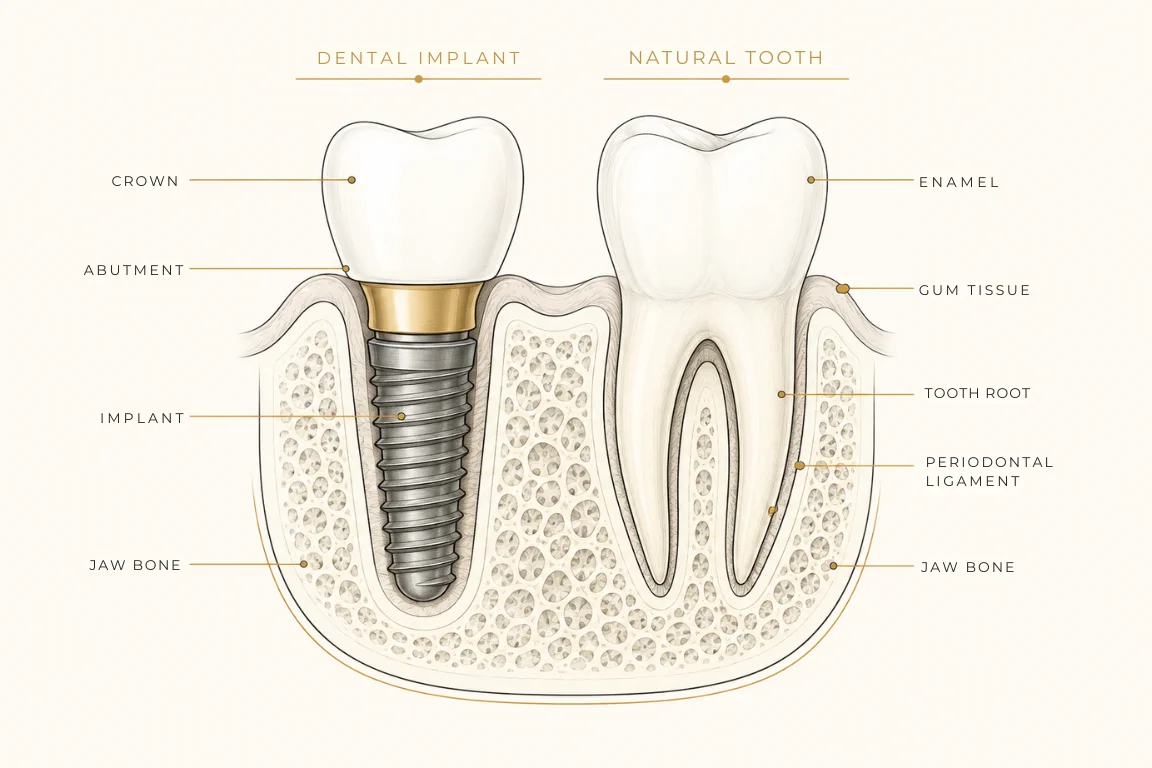
A dental implant is a small titanium post that is placed into the jawbone to take the place of a missing tooth root. Once the bone has grown around it, a custom crown is attached to the post, restoring the visible tooth and the ability to chew normally on that side of the mouth.
The reason implants have become the standard for tooth replacement has less to do with appearance than with what happens beneath the gumline. Jawbone is living tissue that maintains its volume in response to pressure. A natural tooth root delivers that pressure every time you chew. When a tooth is removed and nothing replaces the root, the bone in that area is no longer being loaded and it begins to recede. The jawbone can lose a significant portion of its width in the first year after an extraction, with most of that loss occurring in the first few months.
An implant is the only tooth replacement that restores the root. A bridge or a partial denture replaces the crown of the tooth and restores your ability to chew and smile, but it sits above the gumline and does not transmit force into the bone underneath. That is the practical difference patients are weighing when they ask whether an implant is worth the additional time and cost.
Dr. Khlevnoy has been placing and restoring implants for over 20 years. Every case at Modern Smile Design begins with 3D imaging and a treatment plan, so you understand the sequence, the timeline, and the investment before treatment is scheduled.
Modern Smile Design offers both traditional titanium implants and metal-free zirconia implants. Zirconia is a ceramic material chosen by patients who prefer a biocompatible alternative to metal, and it is also useful in cases where the gum tissue is thin enough that a titanium post could show through as a gray shadow. Dr. Khlevnoy will tell you which material he recommends for your specific site and why.
02
how it works
The Three Parts of an Implant
Patients often picture an implant as a single object. It is three separate components, placed at different times, and understanding the distinction makes the treatment timeline much easier to follow.
PART ONE
The Implant Post
A threaded titanium post placed into the jawbone in the position of the missing root. Titanium is used because bone bonds directly to it, a process called osseointegration. This component is intended to remain permanently and is the part that stabilizes the site.
PART TWO
The Abutment
A small connector that attaches to the top of the implant post and passes through the gum tissue. It is the interface between the part in the bone and the part you see. The abutment is placed once healing is complete and shapes the gum contour around the final tooth.
PART THREE
The Crown
The visible tooth, fabricated from porcelain or zirconia and matched to the shade, translucency, and shape of the teeth around it. We design the crown so that it disappears into your smile rather than announcing itself.
Why the healing period exists. The implant post cannot support chewing force until bone has physically grown into its surface. That biological process, osseointegration, is what separates an implant from a screw sitting in a hole. It typically takes three to six months depending on the site, bone density, and whether grafting was required.
This is also why the timeline cannot be compressed on request. Attaching a crown before integration is complete is the most reliable way to lose an implant.
03
candidacy
When an Implant Is the Right Recommendation
Implants are most commonly recommended in a handful of specific situations rather than as a general upgrade. Dr. Khlevnoy typically discusses implant treatment when one of the following applies:
What Makes Someone a Good Candidate
Three factors carry the most weight: sufficient bone volume at the site, healthy gum tissue, and a medical history that supports normal healing. None of these are pass or fail on their own. Bone volume can usually be rebuilt with grafting. Gum inflammation can be treated before implant placement is scheduled. Conditions such as diabetes are not automatic exclusions, though they do affect how the case is planned and how healing is monitored.
Smoking is the one factor Dr. Khlevnoy will discuss directly. It measurably reduces implant success rates by restricting blood flow to the healing site. Patients who smoke are still treated, but the conversation about timing, expectations, and pausing during the healing window happens before treatment begins rather than after.
04
your options
Implant, Bridge, or Denture
There is no single correct answer for every patient. The right choice depends on how many teeth are missing, the condition of the teeth around the space, your bone volume, and your priorities regarding time and cost. Here is how the three approaches actually compare.
OPTION A
Dental Implant
Replaces the root and the crown. Stands independently, so the adjacent teeth are left completely untouched. Transmits chewing force into the jawbone the way a natural root does. Cleaned like a natural tooth, with floss or interdental brushes.
Timeline: 3 to 6 months typical
Affects neighboring teeth: No
Maintains bone at the site: Yes
OPTION B
Fixed Bridge
Replaces the visible tooth by spanning the gap and anchoring to the teeth on either side. Those two teeth must be reduced and crowned to hold it. Faster than an implant and requires no surgery, which makes it a reasonable choice when the neighboring teeth already need crowns.
Timeline: 2 to 3 weeks typical
Affects neighboring teeth: Yes
Maintains bone at the site: No
OPTION C
Removable Partial
A removable appliance that clasps onto existing teeth. The least invasive and least expensive option, and often the right one when multiple teeth are missing across different areas or when treatment needs to be staged over time. Removed for cleaning.
Timeline: 3 to 5 weeks typical
Affects neighboring teeth: No
Maintains bone at the site: Yes
When More Than One Tooth Is Missing
When several teeth are missing, or an entire arch, implants are used differently. Rather than placing one implant per tooth, a smaller number of implants is used to support a larger restoration.
Implant-Supported Bridge
Two implants support a bridge spanning three or more teeth. Used when several teeth are missing in a row. The natural teeth on either side are left untouched, unlike a conventional bridge.
Full-Arch Implants
A fixed full arch of teeth supported by four to six implants, often referred to as All-on-4 or All-on-X. Used when an entire upper or lower arch needs replacement. The restoration is not removable.
Implant-Retained Denture
A denture that snaps onto implants rather than resting on the gums. Removable for cleaning, but stable while worn. Often the practical middle ground between a conventional denture and a full-arch case.
If the tooth is still in your mouth, there is a fourth option. A tooth that is damaged or infected but structurally sound is often better saved than replaced. If you are weighing extraction against treatment, read our page on root canal therapy before making the decision.
05
the process
What Implant Treatment Involves
Most patients are surprised by how few appointments are actually involved. The length of implant treatment comes from healing time between visits, not from chair time.
Step ONE
Consultation and 3D Imaging (CBCT Scan)
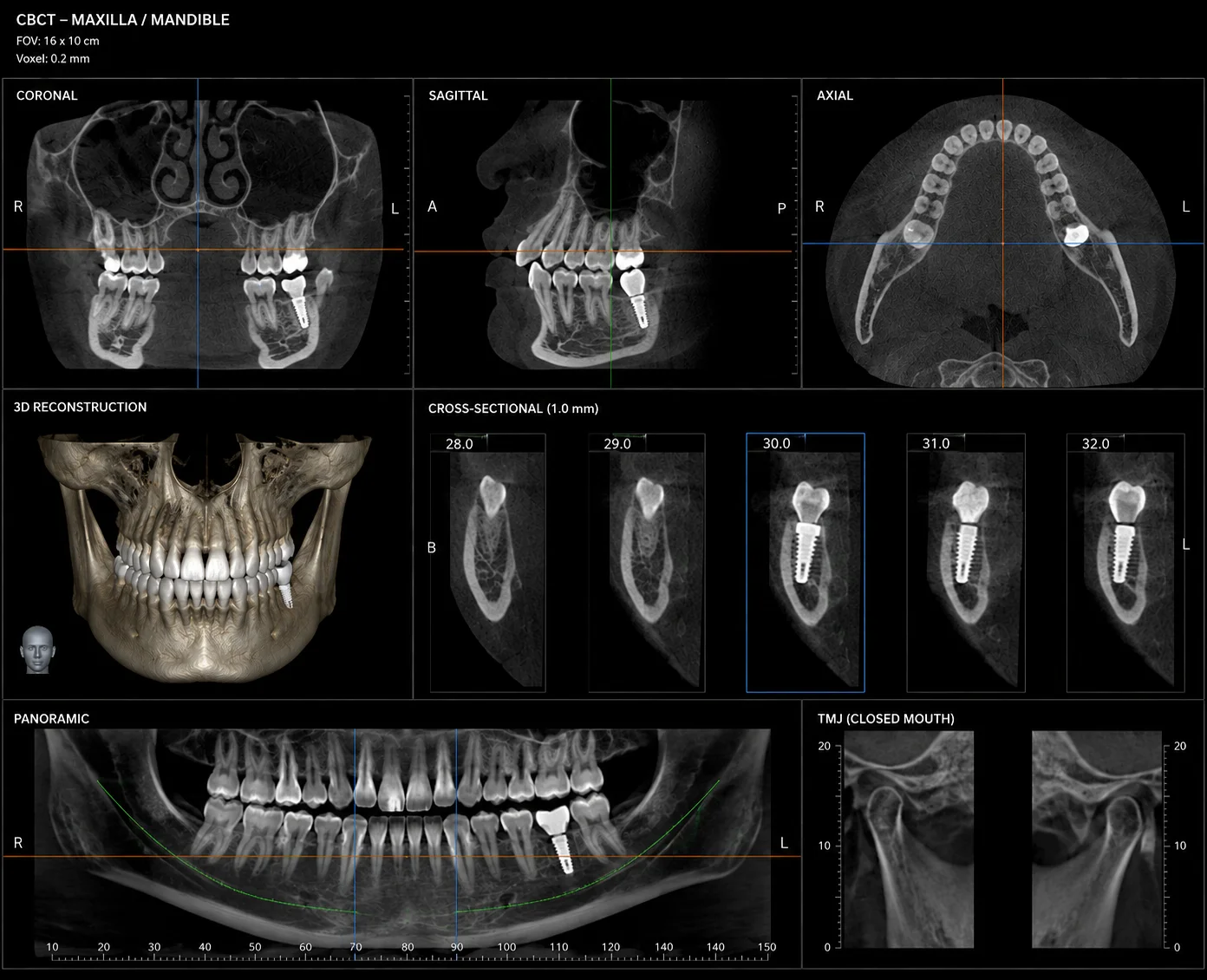
Dr. Khlevnoy or Dr. Dontsova will examine the site, review your medical history, and take a digital scan along with 3D imaging of the jaw. This shows bone height, bone width, and the position of nerves and the sinus, which determines whether the site is ready for an implant or needs to be built up first. You leave with a written plan and a fee estimate.
Step two
Site Preparation, When Needed
If the tooth is still present, it is extracted. In many cases a bone graft is placed into the socket at the same appointment to preserve the site while it heals. If the tooth has been missing for years and the bone has already receded, grafting is performed as its own step, with a healing period before placement.
Step three
Implant Placement
The implant post is placed into the bone under local anesthesia. The appointment generally runs about an hour for a single implant. Most patients report that the recovery is milder than they expected, and noticeably easier than the extraction that preceded it.
Step four
Healing and Integration
Over the following three to six months, bone grows into the surface of the implant. There are no restrictions on daily life during this period beyond the first week of soft food. If the implant is in a visible area, a temporary tooth is provided so you are never without one.
Step five
Abutment and Final Crown
Once integration is confirmed, the abutment is attached and a digital scan is taken for the crown. The crown is fabricated to match the shade and contour of your natural teeth, then seated and adjusted so your bite closes evenly. From this point the tooth is used normally.
06
before treatment
Preparing for Your Procedure
In the Weeks Before
Bring a complete and current list of medications to your consultation, including supplements and anything taken occasionally. Blood thinners, bisphosphonates, and certain immune-modulating medications all affect surgical planning, and Dr. Khlevnoy needs to know about them well in advance rather than on the day of treatment. If you take any of these, he may coordinate directly with your physician before scheduling.
Any active gum inflammation or untreated decay elsewhere in the mouth should be addressed before implant placement. Bacteria do not stay confined to one tooth, and starting from a clean, stable baseline meaningfully improves healing at the implant site. If a cleaning is due, schedule it before the placement appointment rather than after.
If you smoke, this is the period where reducing or pausing makes the largest difference. Dr. Khlevnoy will give you a specific recommendation for the window before and after placement.
The Day Before
- Stock the kitchen. Soup, yogurt, eggs, smoothies, mashed potatoes, and anything else that requires no chewing. Shopping while recovering is worse than shopping ahead.
- Fill any prescriptions in advance so nothing needs to be picked up on the way home.
- Avoid alcohol for at least 24 hours, as it affects both bleeding and healing.
- Arrange your ride if any form of sedation is planned for your appointment.
- Plan for a quiet day after. Most patients are fine to work the next day, but nobody regrets keeping the schedule light.
The Morning of Your Appointment
Eat a normal breakfast before you arrive unless you have been given specific fasting instructions for sedation. Arriving with food in your system reduces lightheadedness and makes the appointment more comfortable, and you will be on softer foods afterward. Brush and floss as you normally would.
Wear comfortable clothing and avoid lipstick or heavy makeup around the mouth. If you use a rinse or premedication prescribed for the appointment, take it exactly as directed and let the team know when you took it. Plan to arrive a few minutes early so that paperwork is not competing with your appointment time.
If You Are Anxious About the Procedure
Anxiety about implant surgery is common, and it is almost always rooted in not knowing what the appointment will actually be like. Tell the team before the day of treatment rather than during it. Dr. Khlevnoy has been placing implants for more than 20 years, and implant surgery is part of our daily schedule at Modern Smile Design. He can walk you through the sequence step by step and discuss comfort and sedation options. Patients who have this conversation in advance consistently report an easier experience than those who try to manage it alone in the chair.
07
after treatment
Post-Operative Care & Healing
What you do in the first week has a direct effect on how well the implant integrates. These instructions are general guidance. The written instructions Dr. Khlevnoy gives you after your specific procedure take precedence over anything on this page.
The First 24 Hours
Keep gentle pressure on the gauze for the first hour, then change it as directed. Some oozing is expected through the first day and is not a cause for concern. Apply a cold compress to the outside of the face in intervals of roughly twenty minutes on and twenty minutes off for the first several hours, which limits swelling more effectively than applying it continuously.
Rest with your head slightly elevated, including while sleeping that first night. Avoid rinsing, spitting forcefully, drinking through a straw, or smoking, all of which create suction or pressure that can disturb the surgical site. Take anti-inflammatory medication as directed before the anesthesia fully wears off rather than waiting for discomfort to build.
Days Two Through Seven
Swelling typically peaks around the second or third day and then steadily improves. This is normal and is not a sign that something has gone wrong. Warm salt water rinses can begin after the first 24 hours, used gently rather than vigorously, several times a day and after meals.
Continue brushing your other teeth normally. Around the surgical site itself, follow the specific instructions you were given, which usually means keeping the area clean without direct brushing until Dr. Khlevnoy advises otherwise. Chew on the opposite side and stay with soft foods, expanding your diet gradually as comfort allows rather than on a fixed schedule. Avoid anything hard, crunchy, or with small particles such as seeds and nuts that can lodge in the site.
Skip strenuous exercise for the first several days. Elevated blood pressure and heart rate during the earliest healing window increase both bleeding and swelling.
Contact the office if you experience any of the following:
- Bleeding that continues heavily beyond the first 24 hours and does not respond to gauze pressure
- Pain that increases rather than decreases after the third day
- Swelling that worsens after day three, or fever
- A bad taste, discharge, or an unusual odor from the site
- Numbness that persists well beyond the expected duration of the anesthetic
- A sensation that the implant or temporary is loose or moving
Call the office at (941) 231-8121. Reaching out early about something minor is always preferable to waiting on something that is not.
Supporting Your Recovery
Healing after implant surgery is a whole-body process, and general wellness plays a real role in how efficiently the body forms bone around the implant. Adequate protein intake, staying well hydrated, and getting genuine rest during the first week all support recovery. General nutritional support such as vitamin D and omega-3 fatty acids may also help as part of overall healing, particularly for patients who have had grafting performed.
These are general wellness considerations rather than prescriptive instructions. Appropriate amounts vary considerably from person to person and can interact with existing medications, so any supplementation should be discussed with Dr. Khlevnoy or your physician rather than started independently.
Tobacco use during the healing window deserves specific mention. Smoking restricts blood supply to the healing bone and is the single most controllable factor working against successful integration. If pausing entirely is not realistic, reducing as much as possible during the first several weeks still helps.
Long-Term Care
Once the final crown is placed, the implant is cleaned like any other tooth. Brush twice daily and clean between the teeth every day, including around the implant. Implants cannot develop cavities, but the gum and bone surrounding them can become inflamed when plaque accumulates, and that inflammation is the most common reason implants fail years after placement. It is also largely preventable.
Keep your regular hygiene appointments. Our hygiene team uses instruments appropriate for implant surfaces and monitors the tissue and bone level around the implant at each visit, which allows any change to be addressed while it is still minor. If you grind or clench your teeth, Dr. Khlevnoy may recommend a night guard to protect both the implant crown and your natural teeth from the forces involved.
08
common questions
Dental Implant FAQs
How long do dental implants last?
The titanium implant itself is designed to stay in the jawbone permanently, and long-term studies show high survival rates well past ten years. The crown attached to it is a separate component and behaves like any other restoration, so it may need replacement after a decade or more of normal wear.
Daily hygiene and regular professional cleanings are the largest factors in how long both parts last. The implants that fail late almost always do so because of inflammation in the surrounding tissue rather than a problem with the implant itself.
Does getting a dental implant hurt?
The placement appointment is performed under local anesthesia, so the procedure itself is not painful. Most patients describe the recovery as milder than a tooth extraction, with soreness and swelling that peak in the first two to three days and resolve with over the counter anti-inflammatories.
Dr. Khlevnoy reviews comfort and sedation options with every patient before treatment begins, and anyone with significant anxiety about the appointment should raise it at the consultation rather than on the day.
How long does the whole process take from start to finish?
A straightforward single implant usually spans three to six months from placement to final crown. Most of that time is healing rather than appointments. The implant needs to fuse with the jawbone before the crown can be attached, and that biological process cannot be shortened.
Cases that require an extraction or bone grafting first take longer. Dr. Khlevnoy gives you a specific timeline after reviewing your 3D scan at the consultation rather than a general estimate.
What happens if I do not have enough bone for an implant?
Insufficient bone volume is common when a tooth has been missing for several years, because the jawbone in that area recedes once it is no longer being loaded. It is usually solvable rather than disqualifying.
Bone grafting rebuilds the site so an implant can be placed, either at the same appointment as the extraction or as a separate step with its own healing period. The 3D scan taken at your consultation determines which approach applies to your case.
Is a dental implant better than a bridge?
They solve the same problem differently. A bridge is faster and does not require surgery, but it depends on the two neighboring teeth for support and those teeth have to be reduced to hold it. An implant stands on its own, leaves the adjacent teeth untouched, and transmits chewing force into the jawbone the way a natural root does.
A bridge is often the better choice when the neighboring teeth already need crowns, since the preparation is happening regardless. When those teeth are healthy and intact, most patients prefer not to alter them.
Am I too old for dental implants?
There is no upper age limit for dental implants. What matters is bone quality, gum health, and general medical status rather than age, and many implant patients are in their seventies and eighties.
Dr. Khlevnoy reviews your medical history and current medications at the consultation to confirm whether implant treatment is appropriate and how it should be sequenced.
Can I get an implant if I smoke?
Yes, though it is a factor Dr. Khlevnoy will discuss with you directly. Smoking restricts blood flow to the healing site and measurably reduces implant success rates, so the conversation about timing and expectations happens before treatment rather than after.
Patients who are able to pause during the weeks surrounding placement and early healing give the implant the best conditions to integrate.
How do I take care of a dental implant?
An implant is cleaned much like a natural tooth: brushing twice daily, cleaning between the teeth every day, and keeping regular hygiene appointments. Implants cannot decay, but the gum and bone around them can become inflamed if plaque accumulates.
That inflammation is the most common cause of long-term implant problems, and professional cleanings allow it to be identified and addressed early.
Does dental insurance cover implants?
Coverage varies widely by plan. Some policies contribute toward the crown but not the implant post, others cover a percentage of both, and some exclude implants entirely.
Modern Smile Design is in network with Delta Dental and accepts most PPO plans. Our team verifies your benefits before treatment so that you receive a written estimate rather than a surprise. Financing through Cherry and CareCredit is available, including zero percent options for qualified applicants.
What if I am missing several teeth?
When multiple teeth are missing, implants are used to support a larger restoration rather than placed one per tooth. Two implants can support a bridge spanning several teeth, four to six can support a full fixed arch, and two or more can be used to anchor a denture so that it no longer moves.
Which approach applies depends on how many teeth are missing, where they are, and how much bone remains. Dr. Khlevnoy reviews all of it at the consultation and gives you a written plan with the options laid out.
Do you offer metal-free implants?
Yes. Modern Smile Design offers zirconia implants in addition to traditional titanium. Zirconia is a ceramic material, so it contains no metal, and it is chosen by patients who prefer a biocompatible option or who have thin gum tissue where a titanium post could show as a gray shadow at the gumline.
Titanium remains the more widely studied material with the longer track record, and it is still the right choice for many sites. Dr. Khlevnoy will explain which he recommends for your case and the reasoning behind it.
What if my tooth is damaged but still in place?
A tooth that is infected or damaged but structurally sound is often better treated than removed. Saving a natural tooth preserves the root, the bone around it, and the ligament that gives the tooth its natural feel, none of which an implant fully reproduces.
Dr. Khlevnoy will tell you honestly which option he recommends for your specific tooth. If the tooth is a candidate for treatment, see our page on root canal therapy.
Let's talk about it
Find Out Whether an Implant Is Right for You
Every implant consultation at Modern Smile Design includes an exam, imaging, and a written treatment plan with transparent pricing before anything is scheduled. You will leave knowing your best options.
Or call us directly at (941) 231-8121